
How to Host a Murder Mystery Party: A Complete Planning Guide
Everything you need to host a murder mystery dinner party — guest count, invitations with character roles, menu, atmosphere, and night-of flow.
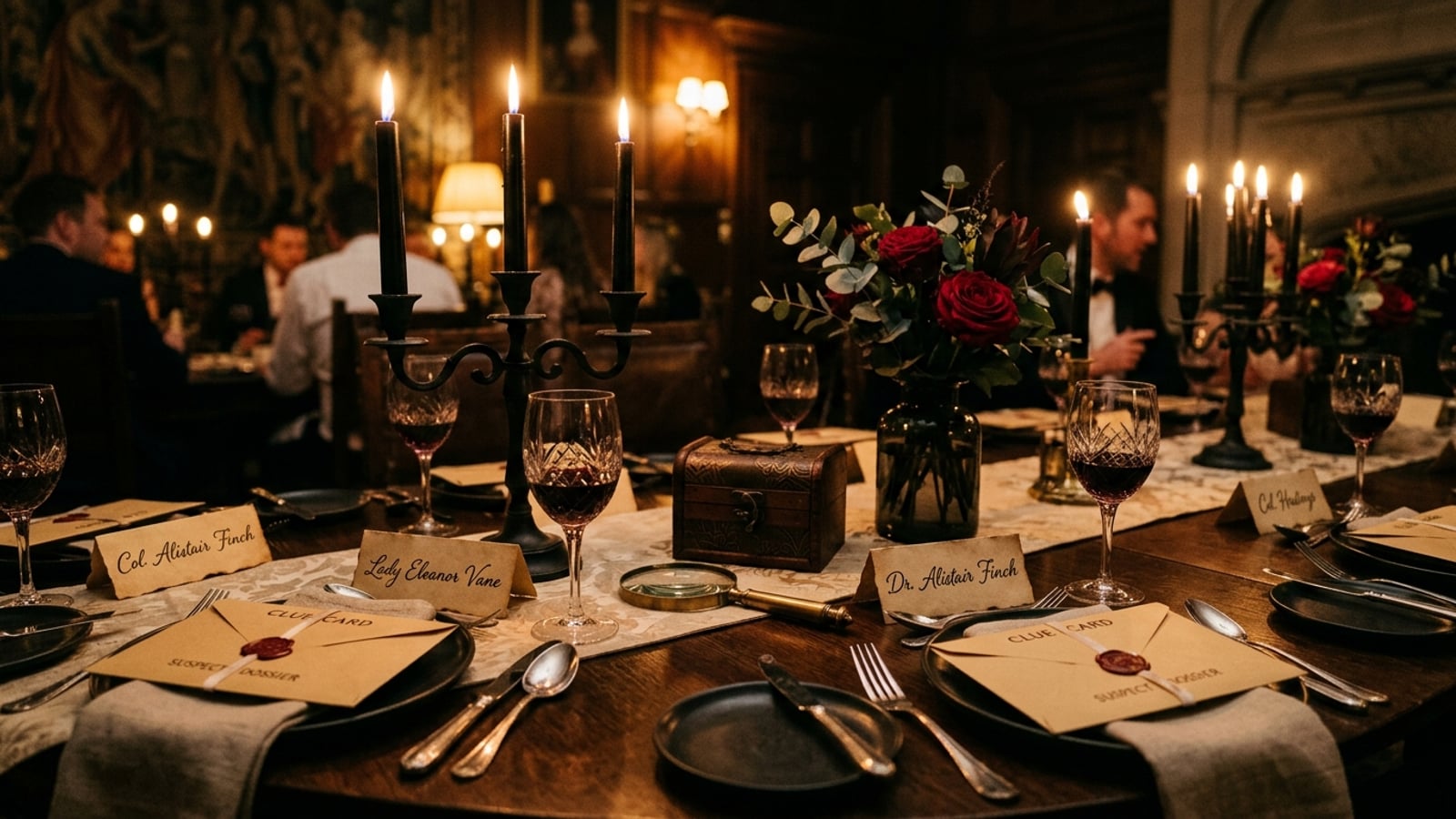
A murder mystery party gives guests something most gatherings can't: a role to play, a problem to solve, and a reason to actually talk to each other. Unlike a standard dinner party where conversation stalls after the first hour, a murder mystery keeps everyone engaged from the moment they walk in — because every guest is a suspect, and nobody wants to be caught.
Here is how to plan one that actually works.
Start with the Right Guest Count
Most murder mystery kits are designed for 6 to 14 named characters, with 8 to 10 guests as the sweet spot. That range gives you enough suspects to keep the web of motives interesting without making the evening too hard to manage. If this is your first time hosting, keep it to 4 to 8 people — smaller groups are easier to run and still deliver the full experience.
For groups larger than 14, shift to a team-based format: instead of each person playing a single character, tables of 3 to 4 guests investigate collectively. This works well for office parties, milestone birthdays, and larger holiday gatherings where a per-person character format would break down.
Kit, Printable, or Write Your Own?
The first real decision is what game you are running. You have three options:
- Boxed kit ($25–$45): Comes with pre-printed character booklets, a host guide, invitations, name tags, and timed dialogue cues. Takes about 30 minutes to read through. Best for first-time hosts who want structure without heavy prep.
- Printable or PDF kit ($10–$30): More flexible for headcounts between 8 and 20. Requires 1 to 2 hours of printing, cutting, and organizing — the savings come at a cost in your time.
- Write your own: A rewarding option if you enjoy the craft, but expect 8 to 15 hours of actual writing work. Rely on plot points and character objectives rather than scripted dialogue, and let guests improvise — tight scripts stall out fast when someone goes off-book.
If this is your first murder mystery party, use a kit. The built-in pacing and pre-written accusation phase keep the evening moving when guests are unfamiliar with the format.
Send Invitations and Character Assignments Together
This is the detail most first-time hosts get wrong: character assignments and invitations must go out at the same time, not separately. Guests need their character information to plan a costume, and costume buy-in is what makes a murder mystery feel immersive rather than just a dinner with trivia.
Send invitations 3 to 4 weeks before the party and ask guests to respond within one week. A tight RSVP deadline matters here more than at a normal event — until you have confirmed headcounts, you cannot finalize character assignments or purchase the right kit.
What to include in each invitation:
- The character name and a brief costume hint
- The dress code and era (1920s speakeasy, Victorian manor, 1970s disco)
- A note to keep their character secret until the evening
- A direct RSVP link so you can track responses in one place
Create a free RSVP page for your murder mystery and track every response — including which character each confirmed guest is playing — without chasing people across text threads.
Manage the Guest List Like the Mystery Depends on It
A no-show at a murder mystery party is a plot problem, not just an empty seat. Every character is connected to other guests through motives, alibis, and secrets. When a character goes missing, there is a hole in the story.
Two practices that help:
- Invite two to three more guests than you have core character slots. Keep a set of minor, flexible roles — a journalist, a bartender, a witness — that can be assigned to late additions without disrupting the main plot.
- Have a backup plan for no-shows. The simplest approach is a one-paragraph character summary the host reads aloud on behalf of the missing guest, treating their absence as part of the story.
For wording that nudges non-responders before your deadline, see our guide to RSVP reminder messages.
Set the Scene
Three elements move the needle most on atmosphere:
- Lighting: Dim the overheads and add candles or string lights. Zone it — brighter where guests examine clues, dimmer candlelit corners for private conversations. This single change does more for immersion than any decoration.
- Music: A themed playlist from the right era starts setting mood the moment guests arrive. Jazz for a 1920s game, classical strings for a Victorian mystery, disco for a 1970s party — it costs nothing and runs in the background all night.
- Props and place settings: Leave a sealed clue envelope at each place setting. A few scattered period-appropriate props — vintage silverware, a locked box, a torn letter — do more than a room full of generic Halloween decorations.
Coherent thematic consistency from entry to dining room is what separates immersive from merely decorated. If you are planning a Halloween murder mystery, the overlap between gothic decor and classic mystery atmosphere makes the setup even simpler.
Plan a Menu That Doesn't Compete with the Mystery
The meal is part of the atmosphere, not the main event. Choose dishes that can be prepared in advance and hold without your attention while you are running the game.
A three-course structure paces the mystery naturally:
- Starters: Stuffed mushrooms, mini quiches, bruschetta, or a charcuterie board — food guests pick at while the scene is being set and characters are introduced
- Main course: Interrogations happen here. A roast, pasta bake, or braised dish you finished before guests arrived keeps you at the table instead of the kitchen
- Dessert: The accusation and reveal phase. Cupcakes, a decorated cake, or individual parfaits — something festive for the payoff moment
For drinks, make signature cocktails or mocktails in bulk the night before and name them after characters or clues. A themed gin fizz for a 1920s speakeasy mystery or a spooky punch for a Halloween game adds to the immersion without any effort on the night itself. Always provide a non-alcoholic option.
How the Evening Flows
Most murder mystery parties run between two and four hours. A structure that works:
- Arrival and cocktails (30 min): Guests meet in character. They introduce themselves by their character name, which breaks the ice faster than a normal party ever could.
- The murder is announced: Usually during or just before the starter course. The host reads the opening scene and distributes initial clues.
- Investigation over dinner: Guests question each other through the main course, gather evidence, and form theories. The host drops additional clues or revelations between courses.
- Accusations with dessert: Each guest submits a written accusation — who did it, how, and why. Read them aloud, then reveal the answer.
The murder mystery format works beautifully as a more structured game night, and the dinner structure gives it a formality that makes it feel like a real occasion. For more on running the dinner side smoothly, see our guide to hosting a dinner party.
When the murderer is revealed, nobody leaves quietly. The reveal moment — whether a guilty confession or a dramatic protest of innocence — is the payoff the whole evening built toward, and it tends to send everyone home already planning the next one.
Ready to collect RSVPs and track character assignments? Create your free murder mystery event page and start confirming your suspects today.
Ready to create your event RSVP?
Build a beautiful event page in minutes. Share one link. Track every response in real time.
Create Your Free RSVP Link