How to Plan a Neighborhood Block Party This Summer
A complete guide to planning a summer block party — permits, invitations, RSVPs, food coordination, and activities for all ages.
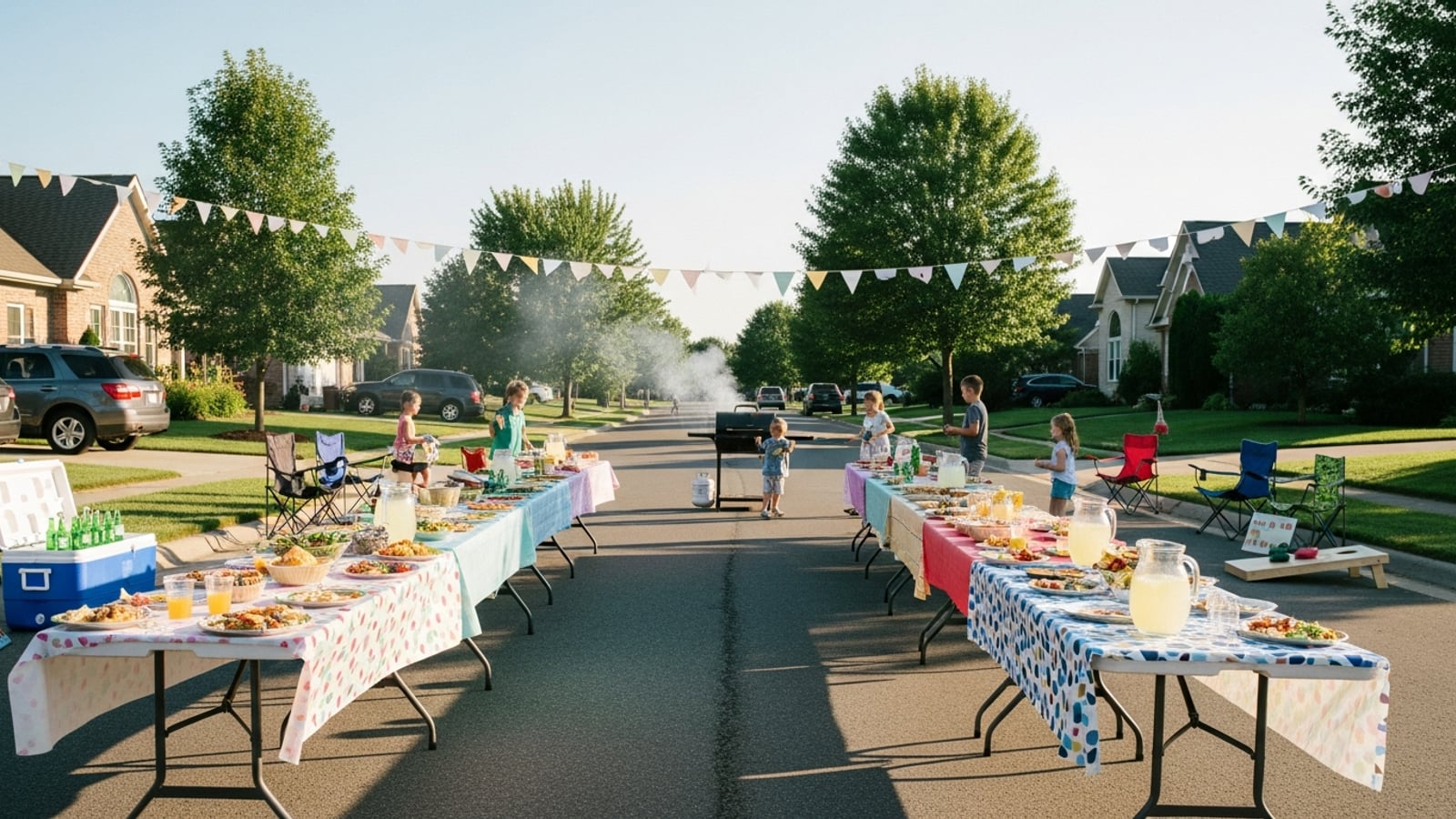
Block parties are one of those events that sounds simple until you are actually organizing one. You are inviting an entire street of people — some of whom you may barely know — and coordinating permits, food contributions, activities, and RSVPs across dozens of households. The good news: with the right sequence, it is very manageable. The key is starting earlier than you think you need to.
If you are planning around National Night Out — the national neighborhood safety event held on the first Tuesday in August — that date in 2026 falls on August 4. That gives you roughly seven weeks from mid-June, which is a good amount of time if you start now.
Step 1: Secure a Permit Before Anything Else
If your block party will close a public street — which most do — you need a permit from your city or county. This is the step people skip until it is too late, and it is the one that can derail the whole event.
Permit requirements vary by city, but the common requirements include:
- A street closure or special event permit application submitted weeks in advance (Portland, Oregon requires at least 15 business days; other cities require more)
- Notification to affected households before you apply
- No-parking signs posted 24–72 hours before the event
- Barricades at the street closure points (cities typically do not supply these)
- Proof of liability insurance for larger gatherings in some jurisdictions
Search your city name plus "block party permit" or "street closure permit" to find the right application. If you are organizing for National Night Out specifically, check whether your municipality waives the permit fee for that event — many cities do as part of the program.
Submit your application 4–6 weeks before the event. Do not leave it to the last minute: permit processing alone can take two to four weeks, and if you are denied or asked for additional documentation, you need time to sort it out.
Step 2: Build a Small Planning Team
One person can organize a block party, but it is significantly easier with two to four neighbors sharing the load. Recruit a small committee early and divide responsibilities clearly:
- Logistics lead: Handles the permit, street closure, barricades, and setup
- Invitations and RSVPs: Manages the invitation, tracks responses, and sends reminders
- Food coordinator: Runs the potluck sign-up and makes sure contributions are balanced
- Activities lead: Plans and sets up games and activities for kids and adults
A four-person committee with clear ownership moves much faster than a single organizer trying to track everything at once.
Step 3: Send Invitations 3–4 Weeks Ahead
Block party invitations should go out at least three to four weeks before the event. That window gives neighbors enough time to clear their schedules while keeping the event top of mind. Sending too early — six weeks or more — means guests forget the details by the time the event arrives.
For a block party RSVP, you want to collect more than just a yes or no. You need household count (adults and children separately) and what each household plans to contribute to the food spread. A dedicated RSVP form handles this far better than tracking responses through a neighborhood group chat or collecting notes slid under doors.
Personal delivery — a knock on the door or a flyer slipped in the mailbox — consistently outperforms digital-only notices for neighbor events. Follow the personal delivery with a digital RSVP link so responses land in one place you can actually manage. Create your block party RSVP page before you send anything so the link is ready to go on the invitation itself.
Your invitation should include:
- Date, start time, and approximate end time
- Location (name the street or cul-de-sac clearly)
- What to bring (your potluck category, chairs, lawn games)
- The RSVP link and deadline
- A contact name for questions
For timing guidance on neighborhood events generally, see our complete invitation timing guide.
Step 4: Coordinate Food With a Potluck Sign-Up
The most practical food model for a block party is the potluck-plus approach: the organizing household covers the main protein — burgers, hot dogs, or whatever you are grilling — plus drinks and ice. Every other household brings one item from a sign-up list.
A free-for-all potluck without assignments risks an imbalanced spread: ten pasta salads and no dessert. A structured sign-up prevents this. Ask each household to claim a category when they RSVP:
- Hot sides (baked beans, corn, grilled vegetables)
- Cold sides (salads, slaws, dips)
- Desserts (cookies, brownies, fruit salad)
- Drinks and ice
- Paper goods or utensils
When contributions are collected as part of the RSVP, you can see gaps immediately and ask specific households to fill them before the event. Our complete potluck hosting guide has more on coordinating dishes across a large group. You can also preview how a BBQ and cookout RSVP page collects this information from guests.
Step 5: Plan Activities for All Ages
A block party without structure gets quiet fast, especially after the initial wave of socializing. Plan a mix of activities that work for kids and adults without requiring a lot of equipment or setup:
For kids: Water balloon toss, three-legged race, hula hoop contest, tug-of-war, sidewalk chalk zone, neighborhood scavenger hunt. Designate one end of the closed street as the kids' activity area so parents can see them while sitting with neighbors.
For adults: Lawn games (cornhole, bocce ball, ladder toss), a neighborhood trivia round, or a chili or dessert cook-off. Cook-offs are particularly effective at block parties because they give neighbors a low-stakes reason to show off something they are proud of, which tends to generate more energy than passive socializing.
Keep activities optional and parallel — not everyone wants to participate in organized games, and that is fine. Have a shaded seating area set up from the start for neighbors who prefer to sit and chat.
Managing RSVPs From Neighbors
Block party RSVPs have a distinct challenge: you are often inviting people you do not know well, which means response rates are lower than for events with close friends and family. Many block party organizers find that roughly half of invited households respond yes — some respond late, and a portion simply never reply.
Build your planning around confirmed RSVPs only. For food quantities, do not estimate for non-responders — plan based on who actually confirmed. A small buffer of extra drinks and a few paper goods is reasonable, but do not buy 20% more food on the assumption that silent neighbors will show up.
Send a single RSVP reminder three to five days before your deadline — at the door if you can manage it, or via the neighborhood app if your block uses one. A personal nudge at this stage captures most of the people who intended to respond but kept putting it off. Our RSVP reminder wording guide has exact language for different situations, including how to ask for a response either way without sounding like you are pressuring anyone.
Day-of Checklist
- Night before: Post no-parking signs along the closure zone (check your permit for the required timing)
- Morning of: Confirm the barricade setup and contact the permit office or city line if anything is unclear
- One hour before: Set up tables, label food stations, and designate the kids' activity zone
- At the start: Station a greeter at the entry point to welcome neighbors, especially those who may not know anyone yet
- At the food table: Label each dish with its name and any common allergens — this takes two minutes and avoids the awkward guessing game at the serving table
Have a simple weather backup plan and communicate it in advance. If the forecast looks uncertain, include a rain date on the invitation or note how you will notify neighbors of any changes.
Starting Small Is Fine
Your first block party does not need to be a production. A closed street, a shared grill, a potluck spread, and a few lawn games is enough. The most important thing is that neighbors show up and talk to each other — logistics are just the scaffolding that makes that possible.
Once you have done it once, the second one is much easier: you know your neighbors, you know what your street enjoys, and you already have the permit process figured out. Many neighborhoods that start with a spontaneous summer cookout end up making it an annual tradition.
Start by creating your block party RSVP link — it takes a few minutes, and having the link ready before you knock on any doors means every neighbor you talk to can respond on the spot.
Ready to create your event RSVP?
Build a beautiful event page in minutes. Share one link. Track every response in real time.
Create Your Free RSVP Link