
How to Host a Costume Party: A Complete Planning Guide
Everything you need to host a great costume party — themes, dress code wording, costume contests, prop boxes, drinks, and timing.
A costume party works for almost any occasion — not just Halloween. Birthday milestones, bachelorette weekends, New Year's Eve, and mid-October "just because" gatherings all become more memorable when guests arrive in character. But unlike most parties, costume events require guests to do significant preparation before they walk in the door. That means your job as host starts much earlier than usual.
Choose Your Theme (or Go Open)
You have two options: pick a specific theme or leave the costume choice open. Both work, but they serve different crowds.
A specific theme — decades (the 1980s, the 1920s), mythology, masquerade, horror movies, video game characters — gives guests helpful direction and makes the party feel cohesive. Every decoration, drink, and playlist choice can reinforce the same world. The trade-off is that narrow themes can frustrate guests who struggle to find a fit. If you go with a theme, keep it broad enough that most people can find a creative interpretation.
Open costume parties ("come as anything") are easier for guests to nail but can produce a random grab-bag of looks. If you go this route, lean into it — the mix is half the fun. Just make the open nature explicit on the invite so guests do not spend weeks searching for a theme that does not exist.
Be Explicit About the Dress Code
The most common costume party mistake is ambiguous invitation wording. Guests arrive in very different levels of effort when the invite says "come in costume" versus "full costume required" versus "costume-inspired outfits welcome." Pick one and use those exact words:
- Costumes required — guests are expected to arrive in a genuine costume; no exceptions.
- Costumes encouraged — costumes are the vibe, but going without one is not unwelcome.
- At minimum, wear one accessory that fits the theme — the most relaxed version; anyone can manage a hat or a pair of novelty glasses.
If you are running a costume contest, mention the categories on the invite — Scariest, Funniest, Best DIY, Best Couple/Group, Most Creative — so guests can plan their look with a prize in mind. That single detail dramatically increases costume effort. See our guide to Halloween party invitation wording for specific phrasing examples that translate well to any costume event, and our dress code invitation wording guide for how to communicate costume expectations with exactly the right tone.
Send Invitations Early
Costume parties need more lead time than a standard party. Send invitations at least three to four weeks out — guests need time to source, borrow, or make a costume, and that does not happen in 48 hours. For a masquerade ball or any event that requires a venue, formal attire, or a more elaborate setup, six to eight weeks is the right window.
An online costume party RSVP page gives guests a clear place to confirm attendance and lets you track headcount in one place. Set one up before you send the invitations — guests should be able to click a link and respond, not hunt for a reply address. Include the costume theme, dress code language, contest categories, and food expectations directly on the RSVP page so everyone has the same information.
Keep a Prop Box at the Door
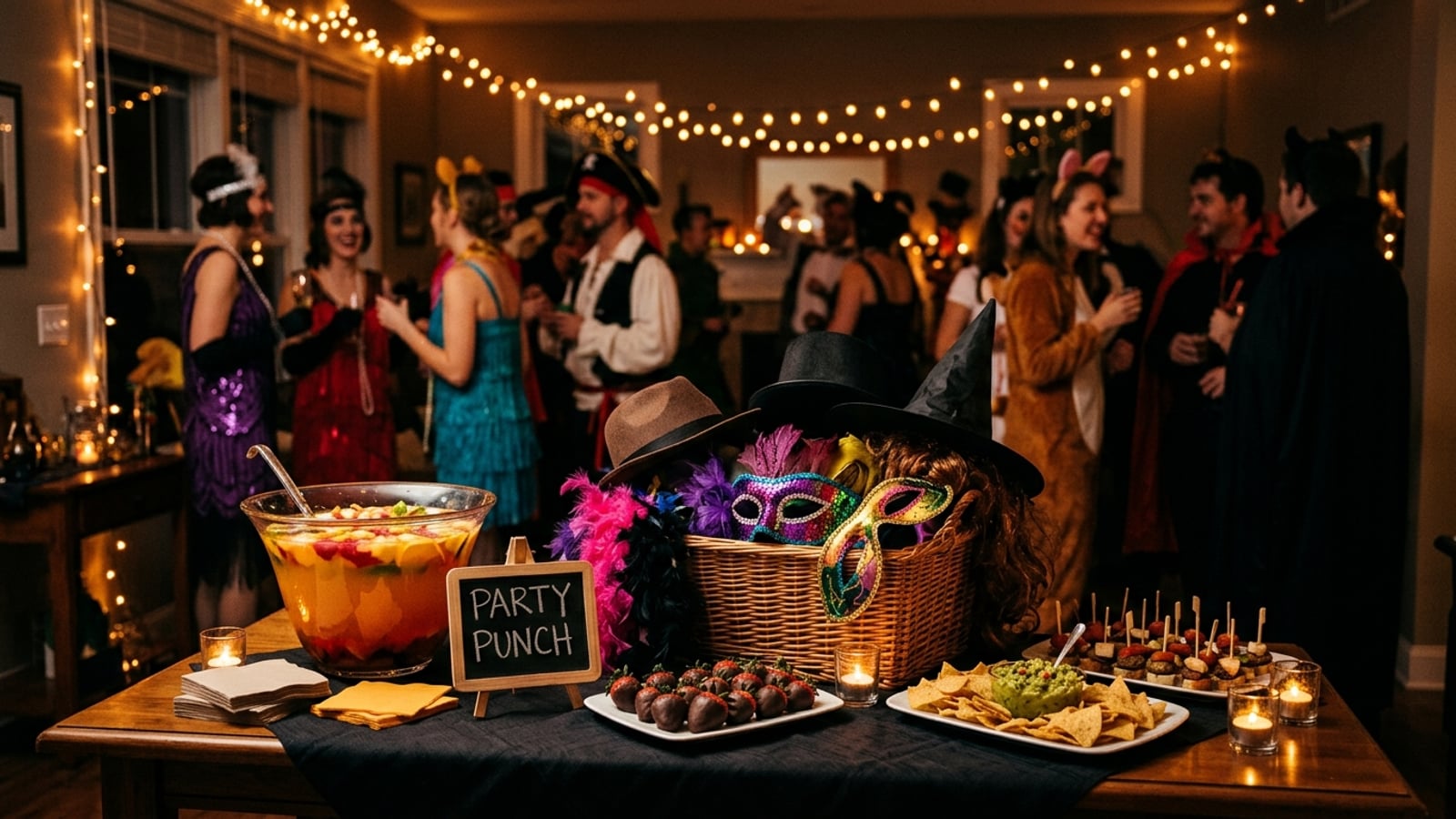
Even with three weeks notice, someone will show up underdressed. A prop box is your insurance policy: a basket or crate filled with wigs, sunglasses, novelty hats, masks, fake mustaches, and costume jewelry. It costs almost nothing to assemble from a thrift store or dollar section, keeps everyone in the spirit, and doubles as entertainment. Guests love digging through it. Leave it near the entrance so it is the first thing people see when they walk in — that way no one feels stranded before the night even starts.
Run the Costume Contest at the Right Moment
Timing makes or breaks a costume contest. Hold it when the room is at peak attendance — usually 90 minutes to two hours after the party starts. Too early and half your guests have not arrived; too late and people are already leaving.
Set up a small stage or clearing for contestants to walk through. Multiple categories beat a single winner because more people feel recognized: Scariest, Funniest, Best DIY, Best Couple or Group, and Most Creative are all crowd-tested picks. Announce the categories in advance on the invitation and in any pre-party reminder — guests who know the categories ahead of time put in noticeably more effort.
For prizes, go on-theme: a horror movie gift basket, a movie-night package (film, popcorn, candy), a small trophy, or a gift card all work well. Even a modest prize makes the contest feel real and motivates effort. Have a clear display area for contestants, announce winners quickly, hand out prizes on the spot, and move on — drawn-out ceremonies lose the room.
Theme Your Food and Drinks
Named drinks are the easiest way to make any costume party feel intentional. A standard rum punch becomes "Phantom's Potion" at a masquerade; an orange lemonade becomes "Witch's Brew" at a Halloween party. The drink itself does not change, but the name creates atmosphere. Make one signature cocktail, one non-alcoholic version of it, and supplement with a self-serve cooler stocked with beer, wine, and sodas — that setup is low maintenance and covers every guest.
Color is your main tool for the food table: red, green, black, and purple all read as theatrical depending on the theme. Dark chocolate-dipped strawberries, layered dips in themed serving ware, or a "bleeding" cake (strawberry preserves inside that pour out when sliced) are all high-impact and low-effort. Lean on store-bought and pre-made items for everything else — your job at the party is to be present and hosting, not to disappear into the kitchen for the first hour.
Lighting, Music, and a Photo Booth
Ambient lighting does more than decorations. Swap standard bulbs for colored LED bulbs (orange, purple, or deep red), place flameless candles around the room, and add string lights or Edison bulbs at the entrance. The effect takes fifteen minutes and transforms the atmosphere entirely.
Build your playlist before guests arrive. For themed parties, find a mix that fits the world — spooky classics, decade-specific tracks, or film scores — then anchor it with enough uptempo songs to keep energy moving. Queue it up before the first guest arrives and walk away from the speaker for the night.
A DIY photo booth is the highest-return addition you can add: a blank wall, string lights, and a handful of costume props from your prop box cost under twenty dollars and give guests something to do, a reason to interact, and a natural icebreaker. You do not need a professional setup — just the space and the props. Guests take their own photos, which means the party memories spread organically after the night ends.
Bring It All Together
Costume parties work when every detail points in the same direction: the invite sets clear expectations, the prop box catches stragglers, the contest runs at the right moment, and the food and atmosphere reinforce the same world. None of it requires a large budget. It requires thinking it through ahead of time.
If you are new to hosting themed parties, start with our guide to hosting a Halloween party for additional seasonal ideas that pair well with any costume event. Then create your free RSVP page, share the link in your invitations, and let guests confirm with one click — knowing exactly who is coming makes every other decision easier.
Ready to create your event RSVP?
Build a beautiful event page in minutes. Share one link. Track every response in real time.
Create Your Free RSVP Link