How to Host a Holiday Open House: A Complete Planning Guide
A holiday open house is the most relaxed way to see everyone this season. Here's how to plan the timing, food, drinks, and invitations for a stress-free event.
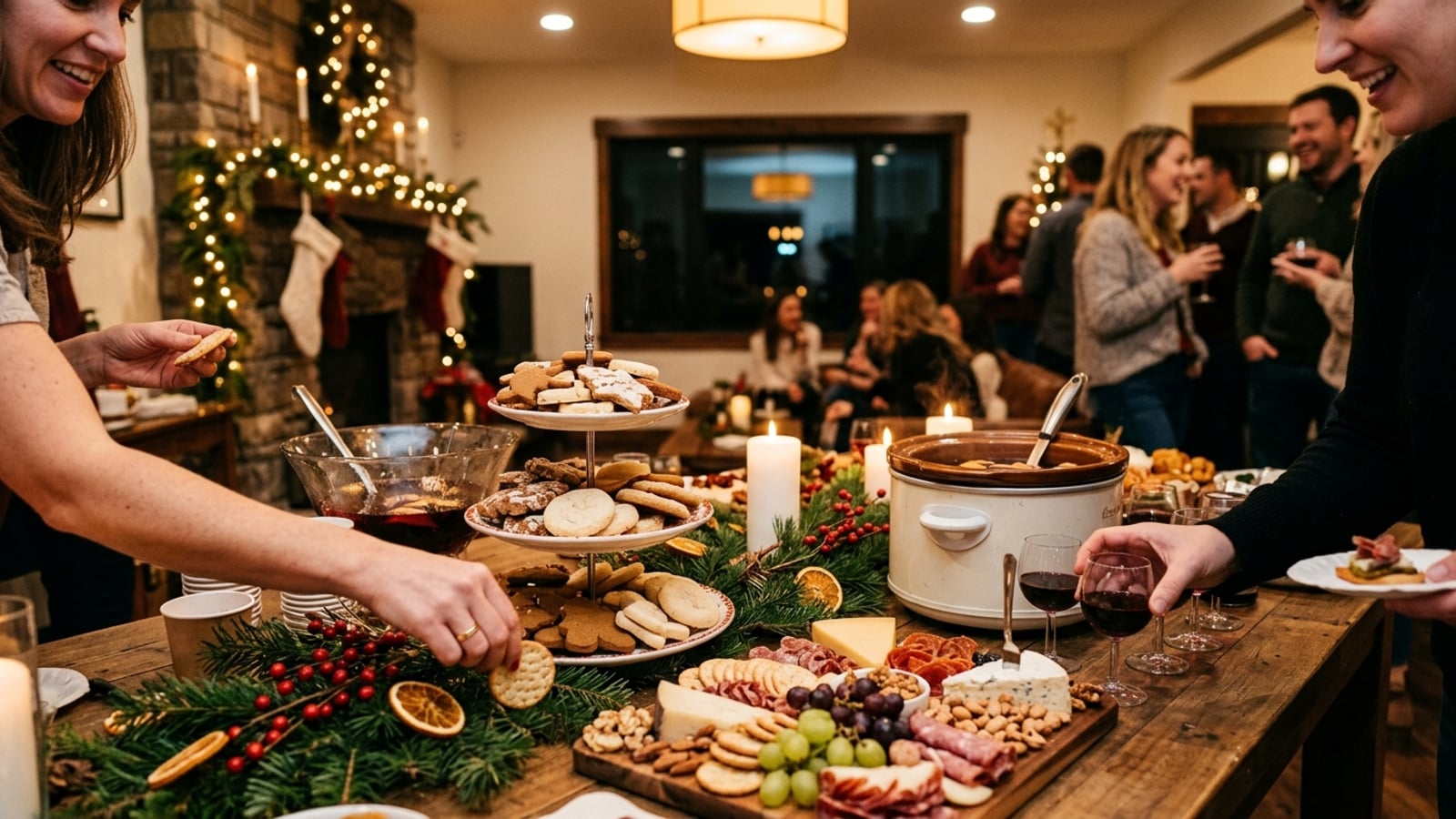
A holiday open house is one of the best parties you can throw in December. Guests come and go on their own schedule, you skip the plated-dinner headache, and you can actually have a conversation instead of sprinting from table to table. The catch is that running a three- or four-hour drop-in event takes a different kind of planning than a seated dinner. Here's exactly how to do it.
Set the Right Time Window
The most common and practical window is 3 to 7 PM or 4 to 8 PM on a weekend afternoon. This lands after guests finish their daytime errands, long enough before a typical bedtime that families with kids can attend, and finishes before late evening — which matters on a December weeknight when people have early mornings.
Print the full window on the invitation, not just a start time. Guests arriving at an open house need to know they can show up at 4 or at 6 — both are fine. A clear end time also signals that the event is winding down and you're not running a party that lasts until midnight.
How Far in Advance to Send Invitations
Send invitations three to four weeks before the event. December is the most crowded social month of the year — people's calendars fill fast. Three weeks gives guests enough runway to block the time; four weeks is better if your crowd tends to travel or has young children with packed weekend schedules.
Open house invitations should be casual and clearly communicate the drop-in format. Something like this:
You're invited to our holiday open house! Stop by anytime between 4 and 7 PM on Saturday, December 13. 220 Birchwood Lane — come as you are, stay as long as you like. RSVP so we know to expect you: [your link here].
The phrase "stop by anytime" does a lot of work — it tells guests they're not expected at a fixed arrival time, which removes a psychological barrier to committing. Create a free RSVP page so you have a running headcount instead of counting texts from a dozen different threads.
Should You Ask for RSVPs at an Open House?
Yes — and many hosts skip this and regret it. An open house can absorb a lot of uncertainty, but you still need a rough headcount to plan food and drinks. Without RSVPs, you're either overbuying and throwing away half the food, or running out at 5:30 while guests are still arriving.
The RSVP ask doesn't need to be formal. Keep it simple: "RSVP so we have a rough headcount" or "Let us know you're coming." Use a dedicated RSVP link rather than asking guests to text you — one dashboard beats managing a pile of messages. See our guide on when to send party invitations for more timing advice.
Plan the Food for a Drop-In Format
The non-negotiable rule for open house food: everything has to work at room temperature. Guests will arrive throughout the window, so nothing can require you to be in the kitchen plating food at 6:15 when the first wave arrived at 4. Build the entire menu around items that can sit on a table for an hour and still be good.
Strong food choices for a holiday open house
- Savory appetizers: baked brie with jam and crackers, bruschetta, a charcuterie board, deviled eggs, stuffed mushrooms, mini quiches, crostini with toppings.
- Holiday sweets: a cookie display is practically expected — decorated sugar cookies, gingerbread, chocolate bark, peppermint brownies. Set these at the far end of the table so guests have to walk past the savory items first.
- A hot dip: spinach-artichoke, warm crab dip, or hot cheesy sausage dip served in a slow cooker keeps hot food on the table without you monitoring it constantly.
- Something for kids: a small separate tray with simpler items (veggies and dip, mini sandwiches) makes a big difference if families are attending.
Plan for about six to eight different items total and keep the serving pieces small. Smaller platters refilled frequently look more abundant than one giant tray that gets picked at.
Drinks: Keep It Simple
A three- to four-hour event does not need a full bar. Pick one signature cocktail (a holiday punch, spiked cider, mulled wine in a slow cooker) alongside a non-alcoholic option (sparkling juice, spiced cider, mocktail punch) plus wine and beer for guests who want something straightforward. Set up the drink station away from the kitchen — this single move prevents a permanent bottleneck at the door.
Label everything and put out a full setup: glassware, ice, napkins, and a small trash basket nearby. Guests at an open house are largely self-sufficient if you give them the tools.
Layout and Flow
Your home's layout will determine how well the party flows. A few principles:
- Spread food across two or three areas instead of one table. Guests naturally cluster where food is — if it's all in one place, so is the crowd.
- Put the drink station in a separate room from the main food table if you can. It splits the traffic pattern and prevents one room from becoming impossible to move through.
- Create a coat drop zone immediately at the entrance. A bedroom with a coat rack, or a visible row of hooks in the entryway, prevents every arriving guest from asking where to put their things.
- Mark the bathroom. On a night when you're welcoming dozens of people who may never have been to your house, a small sign or note pointing to the bathroom saves everyone an awkward interruption.
How Many People to Invite
The open house format lets you invite a larger guest list than a seated dinner because not everyone arrives at the same time. A general rule: expect about half your RSVPs to be present at any given moment during the party. If you have space for 30 people comfortably at once, you could invite a list of 50 to 60 with confidence that the crowd will stagger naturally across the three- or four-hour window.
That said, check your RSVPs before finalizing food quantities. If 70 of 80 people confirm they're coming, plan accordingly — you won't always get a perfectly staggered crowd.
Day-Before Prep: What to Do Before Guests Arrive
- Set the tables and label every platter the night before. Use sticky notes — one platter for brie, one for the cookie display, etc. This eliminates a surprising amount of morning-of chaos.
- Make or buy everything that doesn't need last-minute prep. Cookies, brownies, charcuterie components, dips that reheat in a slow cooker — all of these are day-before tasks.
- Set out glassware, plates, and napkins. Lay out the drink station completely minus the ice.
- Prep a playlist. Three to four hours of background music with no repeats.
The goal is to spend your event day making a handful of fresh items and doing a final decor pass, not setting up the entire party from scratch.
Invitations and Wording
Check out a live Christmas party RSVP example to see what guests experience when they respond. For the wording, the most important thing to communicate is the drop-in nature of the event and the full time window. Guests are used to parties with a single start time — an open house is a different format and you need to spell it out.
For more wording examples, see our guide on Christmas party invitation wording, which includes open house and casual gathering options. For guests who may also be hosting their own holiday events, linking to a cocktail party RSVP example shows the style of a light, mingling-friendly event invitation.
The Day-Of Checklist
- Add ice to drink station 30 minutes before guests arrive.
- Put out all food items 15 minutes before the window opens.
- Start the music.
- Light any candles or turn on accent lighting.
- Check that the bathroom is stocked and tidy.
- Have a refill plan: designate which trays need restocking first and keep backup in the fridge.
An open house is designed to be low-pressure — once guests start arriving, your main job is greeting people and refilling the brie. The prep work happens before the party, not during it.
Ready to create your event RSVP?
Build a beautiful event page in minutes. Share one link. Track every response in real time.
Create Your Free RSVP Link